Counting the Omer with kids: a 49-day countdown that turns waiting into something.
Every night between Pesach and Shavuot, Jewish families count one number out loud — building day by day toward the holiday when Hashem gave us the Torah at Har Sinai. It is the longest, slowest, most beautiful countdown in the Jewish year. This post is a free guide for parents with K–3 kids — how the count works, what to say at bedtime, four kid-friendly ways to make it visible, and the Hebrew vocabulary that will stay with your child for life.
Posted May 14, 2026 · Reading time: ~7 minutes
What is the Omer, in one paragraph?
The Omer (הָעֹמֶר) was originally a measure of barley brought to the Beit HaMikdash on the second day of Pesach. The Torah tells us to count seven full weeks from that day — 49 days — and then, on the 50th day, to celebrate Shavuot. We don't bring the barley offering today, but the count remains. Every Jewish family that observes the count says one number out loud each night, building from "today is day one of the Omer" all the way up to "today is forty-nine days, which are seven weeks of the Omer." Then Shavuot arrives. The whole stretch is called Sefirat HaOmer (סְפִירַת הָעֹמֶר) — "the counting of the Omer."
Why we count up, not down
If you've ever counted down to a birthday with a child, you know the feeling — the number gets smaller and the excitement gets bigger. Sefirat HaOmer goes the other direction. We count up. Day one. Day two. Day twenty-three. Day forty-nine.
There's a beautiful reason for this. The number we just said reflects how far we've already come — how much of ourselves we've already prepared. After the Exodus from Mitzrayim, our family wasn't ready to receive the Torah right away. They needed seven weeks of becoming ready. Each night they counted, and each night they were a little more ready than the night before. We do the same.
For a K–3 kid, you can put it like this: "Last year on Shavuot night, you weren't quite the same person you are today. This count is how we get ready, one day at a time, to receive the Torah again — fresh, new, just like the very first time."
The bracha — said at night, after dark
The traditional time to count is in the evening, after stars come out. Before counting, we say:
בָּרוּךְ אַתָּה ה׳ אֱלֹקֵינוּ מֶלֶךְ הָעוֹלָם, אֲשֶׁר קִדְּשָׁנוּ בְּמִצְוֹתָיו וְצִוָּנוּ עַל סְפִירַת הָעֹמֶר.
Baruch atah Adonai, Eloheinu Melech ha'olam, asher kid'shanu b'mitzvotav v'tzivanu al sefirat ha'omer.
"Blessed are You, Hashem our G-d, King of the universe, who has sanctified us with His commandments and commanded us about counting the Omer."
Then say the count for that night — for example: "Today is the twenty-third day, which is three weeks and two days of the Omer."
Four kid-friendly ways to make the count visible
The count is short — a bracha plus one sentence. The reason it can feel like the family doesn't keep up isn't that it's hard; it's that it's invisible. So make it visible. Pick one of these and stick with it:
1. The 49-square sticker chart
Print a grid of 7 columns and 7 rows on a single sheet of card stock. Each row is a week. Each square is a day. Number them 1 through 49. Tape the chart to the fridge or your child's bedroom door. Buy a sheet of metallic gold star stickers. Each night after the bracha, your child gets to peel a star and stick it on tonight's number. By Shavuot, the chart is a wall of gold — proof of every night your family showed up.
2. The countdown jar
Two clear glass jars, one labeled "to count" and one labeled "counted." Fill the first with 49 marbles, glass beads, or polished river rocks (kids love picking the medium). Each night, your child moves one stone from the first jar to the second. Watching the "counted" jar fill — and the "to count" jar empty — gives the abstract number a physical shape. By Shavuot the second jar is heavy and full.
3. The seven-week kindness chain
This one is for older K–3 kids who like a challenge. The Omer has a 7×7 structure — seven weeks of seven days. Pick a kindness theme for each week: gratitude, sharing, patience, listening, helping, saying sorry, joy. Each day, your child does one small thing in that week's theme and adds a paper link to a chain that hangs across the kitchen. By the time you reach Shavuot, the chain has 49 links — and your child has 49 small acts of kindness behind them.
4. The bedtime two-minute count
If charts aren't your style, just make the count itself a bedtime ritual. Lights low. The whole family in one room. One child a night gets to lead — they say the bracha, they say the number, everyone says amen. Two minutes total. By the third week, your kid will know the bracha by heart.
The 7×7 rhythm — seven weeks of seven days
The Omer's structure isn't accidental. Every seven days makes a complete week, and every seventh week brings us closer to Shavuot. Some families mark each new week with a small celebration — a special dinner, a new fruit, a thank-you note to a relative. If you want to anchor the count in something bigger than just the number, the weeks give you natural beats:
- Week 1: The week of leaving Mitzrayim — the freedom we just celebrated at Pesach.
- Week 2: Becoming a family of free people — what does freedom let us do?
- Week 3: The journey through the desert — patience.
- Week 4: Halfway. Looking back at how far we've come.
- Week 5: Getting closer — preparing our hearts.
- Week 6: Almost there. The mountain on the horizon.
- Week 7: Final week. Anticipation.
Hebrew vocabulary to introduce
| Word | Hebrew | Say it like |
|---|---|---|
| HaOmer (the Omer) | הָעֹמֶר | ha-OH-mer |
| Sefirat HaOmer (the count) | סְפִירַת הָעֹמֶר | s'fee-RAHT ha-OH-mer |
| Yom (day) | יוֹם | yome |
| Shavua (week) | שָׁבוּעַ | sha-VOO-ah |
| Shavuot (weeks · the holiday) | שָׁבוּעוֹת | sha-voo-OAT |
| Bracha (blessing) | בְּרָכָה | b'ra-KHA |
| Amen | אָמֵן | ah-MAIN |
| Layla tov (good night) | לַיְלָה טוֹב | LIE-la tove |
What if my child asks the hard question?
Sometimes a child asks: "Why do we have to count? What's the point?"
Here is a framing that works for K–3:
"When something really good is coming, sometimes the waiting is part of the gift. Counting the Omer is how Jewish families have practiced waiting — together, on purpose, for almost three thousand years. Every night the number we say is a tiny promise that we are still here, still ready, still excited for the day Hashem gave us the Torah."
That is accurate. It is age-appropriate. It does not require a 1st grader to wrestle with the kabbalistic structure of the seven sefirot of mussar work — that's for when they're older.
About the Omer's mourning customs
You may know that for many communities, parts of the Omer period are also a time of restraint — no haircuts, no weddings, no live music for some or all of the count. The reasons are historical and beautiful, but they're not for K–3 kids. If your child notices that someone in your community looks different, you can say: "Some grown-ups don't cut their hair during the Omer. It's a quiet way of remembering — we'll learn the whole story when you're a little older." Then change the subject back to the count.
And then — Shavuot.
On the 49th night, you'll say the last bracha and the last count: "Today is forty-nine days, which are seven weeks of the Omer." Your child will high-five you. The chart is full of stars. The jar is heavy with stones. The kindness chain reaches across the room.
And the next night, you'll be in shul or at your dining-room table for Shavuot itself — the holiday the count was reaching toward all along. The Torah we received at Har Sinai. The cheesecake. The flowers. The whole celebration that Jewish families have built around this one day for thousands of years.
The count was the runway. Shavuot is the takeoff.
Want a complete Shavuot lesson, ready to teach?
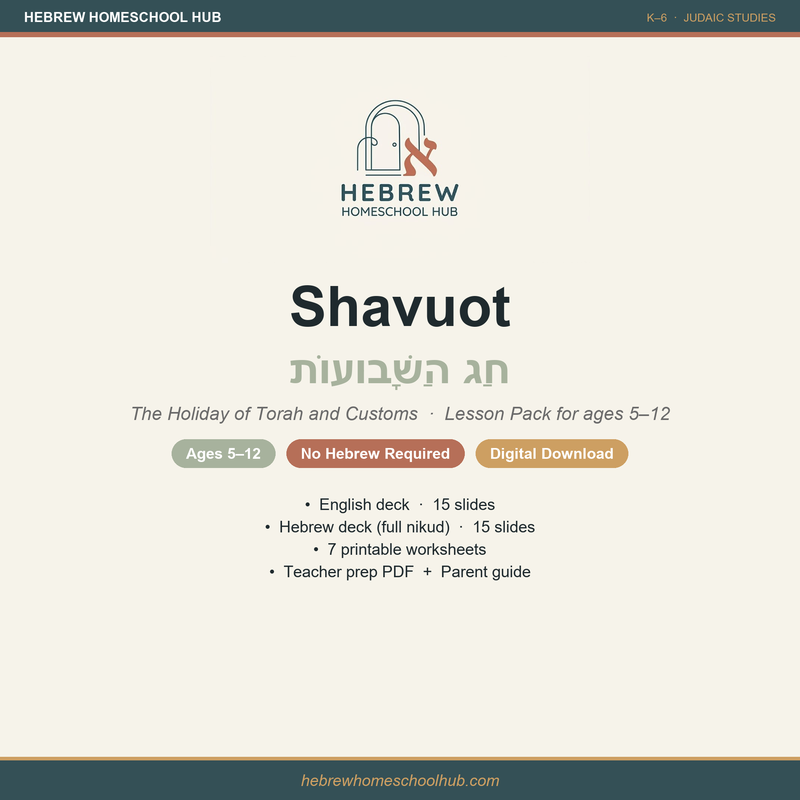
The Hebrew Homeschool Hub Shavuot lesson pack is the full thing — a 15-slide English deck, a vowelized Hebrew deck, an 8-page printable worksheet pack, a 15-page teacher prep PDF, an 11-page parent guide with lesson plans, and a 1-page scope & sequence. Use it the night the Omer ends, or as the centerpiece of your Shavuot homeschool morning.
Single-family digital download. Yours forever, free updates included.
Frequently asked questions
When does the Omer count start and end?
The count begins on the second night of Pesach and runs for 49 nights — seven full weeks. On the 50th day, Shavuot arrives. In 2026, the count began Wednesday night April 22 and ends Wednesday night June 10; Shavuot starts at sundown June 10.
What if we miss a night?
If you forget at night, you can still count the next day — without the bracha — and continue counting with the bracha the following nights. If you miss a full 24-hour period (no count at night and no count the next day), traditional practice is to keep counting on the remaining nights but without the bracha for the rest of the cycle. For young kids, just pick it back up the next night and don't make a big thing of it.
Do kids say the bracha?
Yes — once a child can speak the words clearly, they can say the bracha and count. Many families let one child a night lead the count, which turns the count into the highlight of bedtime. The full Hebrew text with nikud is in the parent guide of our Shavuot lesson pack.
Is the Omer a happy time or a sad time?
Both, depending on the day. The count itself is forward-looking — we're counting up to receiving the Torah. But large parts of the Omer period are also a traditional time of semi-mourning (no haircuts, no weddings) for many communities. For K–3 kids, lean into the anticipation — the count is the rhythm of waiting, like a 49-day advent calendar pointing toward Shavuot.
What's Lag BaOmer?
The 33rd day of the Omer (lag = the letters lamed + gimel = 33) is a small festival within the count when most mourning customs lift for a day. Many communities have bonfires, picnics, and outdoor games. It's a wonderful midway pause in the count — a chance to celebrate how far you've come and rest before the final stretch.
Can I teach this if I don't read Hebrew?
Yes. Every Hebrew word in this post is transliterated. The Shavuot pack also includes a pronunciation cheat sheet in the parent guide. You can lead the count and the bracha confidently without reading a single Hebrew letter — though by the end of 49 nights, your child will recognize the bracha words on sight.
More from Notes from the Hub
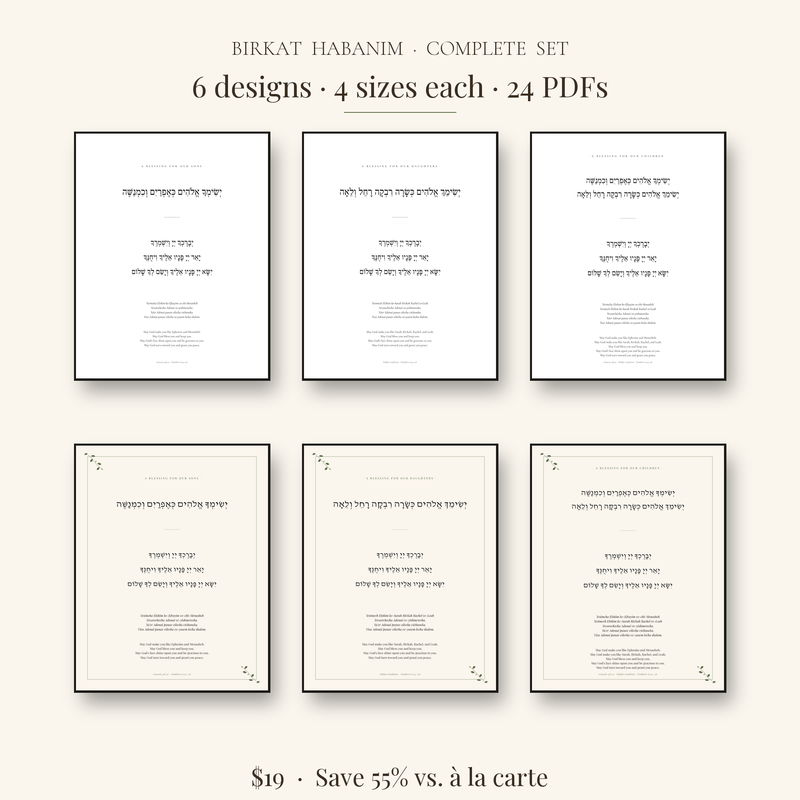
Blessing our children on Shabbat בִּרְכַּת הַבָּנִים
A free Friday night guide — the words for sons, daughters, and mixed families, when to do the blessing, and what to do if you don't read Hebrew.
Read the guide →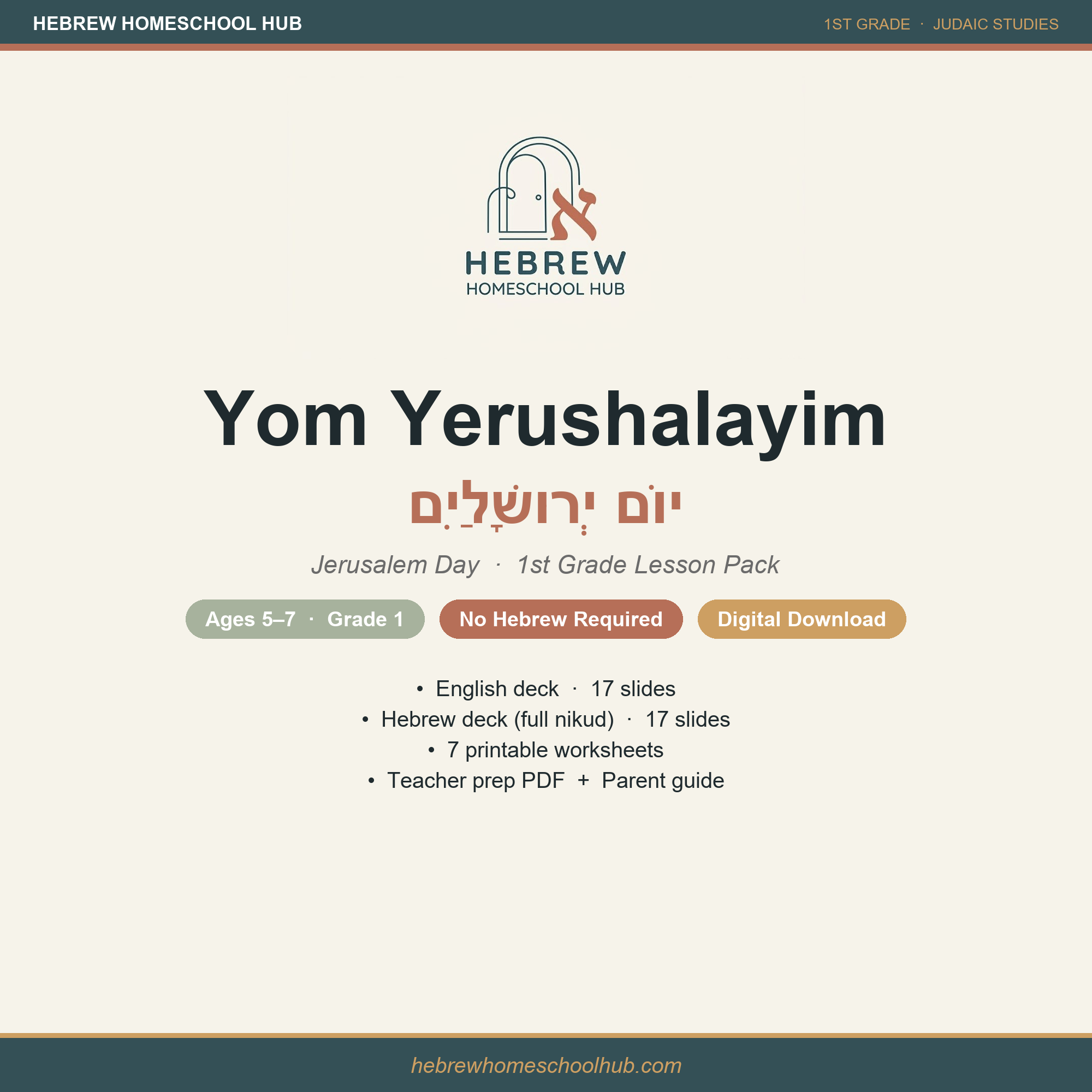
Yom Yerushalayim for kids יוֹם יְרוּשָׁלַיִם
A 30-minute K–3 lesson on the 8 gates of the Old City, the Kotel, and the joy of reunification.
Read the lesson →Related packs in the series
Shavuot חַג הַשָּׁבוּעוֹת
Where the count lands. The Holiday of Torah and Customs — 15 slides, 8 worksheets, full parent guide.
See the pack →
Pesach חַג הַפֶּסַח
Where the count starts. The Holiday of Freedom — 15 slides on the Seder, the Four Questions, and Yetziat Mitzrayim.
See the pack →